

The 43rd International Battery Seminar wrapped up last week at the Rosen Shingle Creek in Orlando, and the EMS team is back with full notebooks and a better read on where the battery industry is headed.
For those not familiar, the International Battery Seminar is not a typical trade show. It is the longest-running annual battery industry event in the world, organized by Cambridge EnerTech since 1983.
OEMs, cell manufacturers, materials scientists, national labs, pack integrators, and policy makers all show up at the same time and actually talk to each other.
This year brought more than 2,000 attendees and upward of 248 speakers to a new venue for the Seminar, with sessions running across EV battery applications, next-generation research, high-performance manufacturing, grid storage, safety standards, and more.

Engineered Materials Solutions was set up at Booth #312 on the exhibit floor, alongside a mix of materials suppliers, cell chemistry developers, test and measurement companies, and manufacturing technology providers.
The conversations at our booth covered the usual range of applications, from EV battery interconnect design to grid storage busbar materials, and our SigmaClad® product drew the kinds of questions that tell you people are thinking seriously about thermal and conductivity performance, not just spec-shopping.
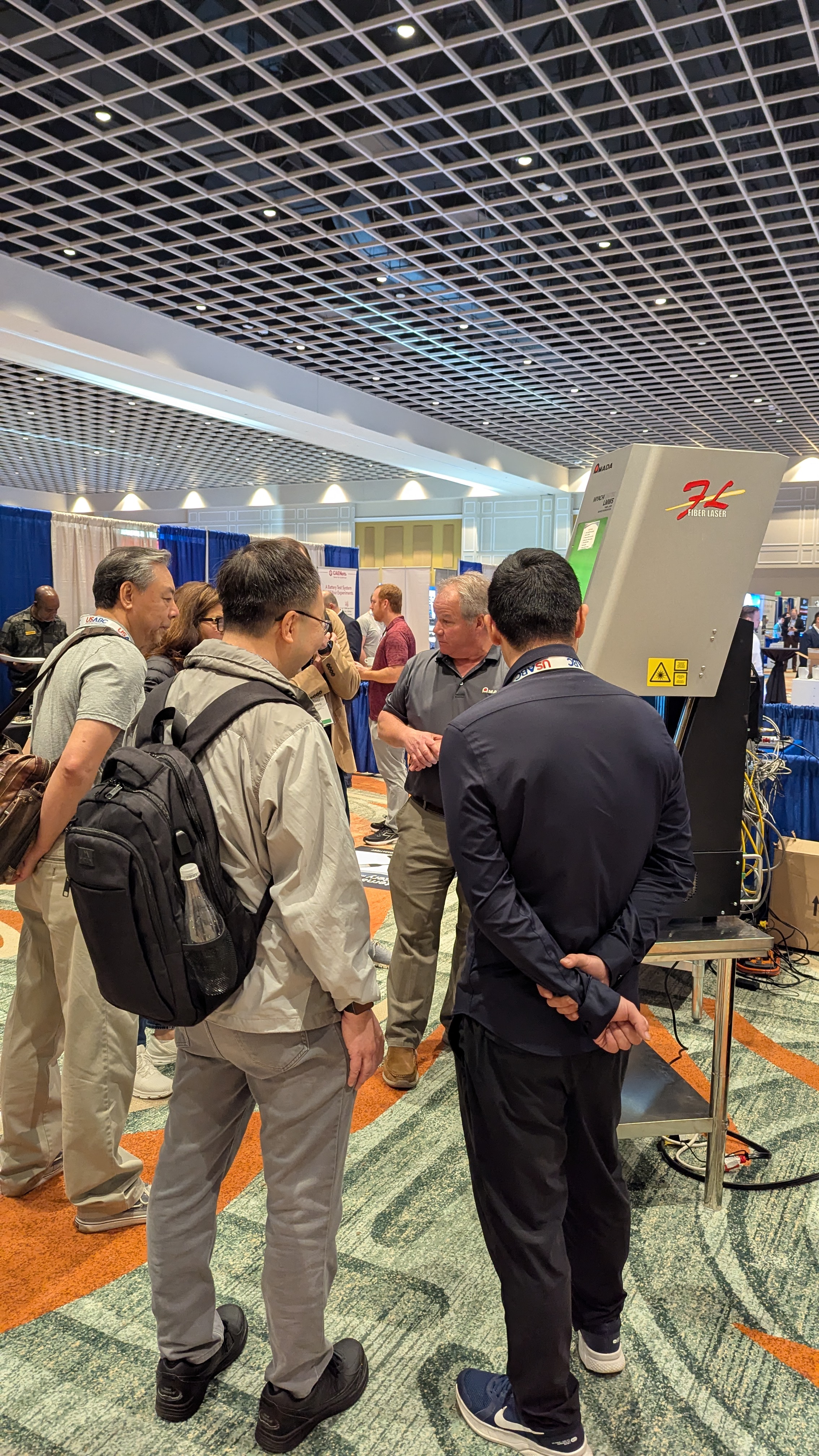

One of the more interesting side conversations involved Amada’s weld monitoring and tracking software, which one of our team members got a close look at on the floor.
There was also no shortage of forward-looking technology on display.
IKA Works had an interesting demonstration underway nearby, with attendees testing new technology through VR.
Walking through the conference programming, one theme kept surfacing in different forms: how do you keep building on what works today while staying open to what is coming next?
Battery development does not move in a straight line.
There are proven chemistries and architectures that OEMs have built entire production systems around. And then there are a handful of technologies sitting just over the horizon, each one promising to change the way batteries are designed, built, or used.
The tension between those two realities was present in nearly every room.

Below are the technologies that came up most consistently, both in the sessions and in conversations on the floor.
One of the panels that generated the most attention was titled exactly what the industry is thinking: Dry Battery Electrode (DBE) Manufacturing is Inevitable: Adopt or Fall Behind.
The conventional way to make battery electrodes involves mixing active materials into a liquid slurry using a toxic solvent called NMP (N-methylpyrrolidone), coating that slurry onto metal foil, then running the coated foil through long, energy-intensive drying ovens to pull the solvent out. The solvent has to be recovered after, which means more equipment and more cost. The cost of the solvent drying and recovery process accounts for approximately 40% of the total lithium-ion battery manufacturing cost, representing significant energy consumption. ScienceDirect
Dry battery electrode processing eliminates that entire step. Instead of slurry, manufacturers work with dry powder mixtures that are deposited directly onto the current collector, with heat and pressure doing the bonding work. This technology eliminates toxic solvents, cuts energy use by 25%, and could reshape how lithium-ion batteries for electric vehicles and energy storage are made. Highstar
The performance story is getting harder to ignore too. LiCAP Technologies claims its dry electrode process can reduce energy use by about 40% and overall battery manufacturing cost by up to 50%. Charged EVs
Those numbers require independent validation at scale, but the direction is consistent across multiple developers. And in February 2026, Tesla officially announced that both the cathodes and anodes of its 4680 batteries are now manufactured using the dry method which “significantly reduces costs, energy consumption, and factory complexity.” Neware
The panel framing was not subtle. For manufacturers that have already committed hundreds of millions of dollars to wet-process gigafactories, this is not a comfortable conversation. But the data is pointing in one direction, and the companies building new production capacity are paying attention.
Solid-state batteries have been discussed as the next major step in battery technology for the better part of a decade. The case for them has not changed: replace the flammable liquid electrolyte with a solid material, get a safer cell, enable a lithium-metal anode, and unlock meaningfully higher energy density. Today’s best lithium-ion batteries deliver 200 to 300 Wh/kg. Solid-state batteries are targeting 400 to 500 Wh/kg commercially, with potential to reach 500 to 600 Wh/kg in the coming years. To7motor
The honest status report from IBS 2026 is that the promise is real, but the timeline remains genuinely uncertain.
As of 2026, the solid-state battery market has yet to reach scalability and commercialization. Wikipedia
Multiple major OEMs and cell manufacturers have announced timelines and then quietly revised them. Solid-state batteries promise safer, higher-performance, and longer-lasting energy storage, but scaling them from lab innovation to mass production remains the industry’s greatest challenge. Internationalbatteryseminar
Benchmark Mineral Intelligence put the picture in clear terms during one of the automotive battery sessions: battery evolution is occurring in many different directions, with each avenue viewed as the next big thing.
Developments include advancements in LFP chemistry with LMFP, the use of silicon anodes, sodium-ion, and the emergence of ultra-fast charging technologies. However, solid-state batteries have gained interest for over a decade now.
Ford’s cell technology team added useful grounding: when there is this much attention and capital pointed at a technology, separating legitimate progress from competitive positioning is hard.
The material science and manufacturing challenges around solid electrolytes, particularly interface resistance and dendrite suppression at scale, are real engineering problems that do not resolve on press-release timelines.
The expectation heading out of IBS is semi-solid battery cells in limited production now, small-series solid-state EV cells around 2027, and meaningful volume production by 2030, assuming interface and yield challenges continue to improve.
Cylindrical lithium-ion cells have long used metal tabs to connect the current collectors to the terminals. These tabs act as the path for current to flow out of the electrode layers and into the external circuit. While this design has been reliable for decades, it introduces limitations, particularly for high-power applications. Battery Design
In a tabbed cell, current is forced through relatively narrow contact points. This leads to higher internal resistance, uneven current distribution, and greater I2R heating during high-current operation. It can also create localized thermal hotspots, which may limit performance or complicate thermal management. Battery Design
Tabless architecture solves this by letting the entire electrode edge conduct current, spreading the load across the full surface area rather than routing it through a discrete tab. Distributed connections spread the heat evenly across the electrode edges, resulting in cooler operation, lower risk of thermal runaway, and improved cycle life. Trydan Tech
Tesla’s 4680 cell put tabless design on the radar for the broader industry in 2020, and adoption has been accelerating. Recently, cylindrical cells have received increased attention since Tesla announced their tabless 4680 cell. German automotive manufacturer BMW followed, announcing it will utilize 46xxx cylindrical cells in its “New Class” that began production in 2025. Wiley Online Library
For materials suppliers focused on tab and interconnect design, tabless architecture changes some of the engineering conversation without eliminating it. The current collection path looks different, but thermal performance, weld quality, and conductivity at scale are still live design questions.
Beyond those three headliners, a few other technology directions came up repeatedly across sessions.
Silicon Anodes. Graphite-based anodes have a theoretical ceiling on energy density. Silicon holds roughly ten times more lithium per gram, which means meaningfully higher capacity cells if silicon expansion during cycling can be controlled. Several cell manufacturers are shipping silicon-composite anodes in commercial products today, and research at Argonne National Laboratory and elsewhere is working through the remaining mechanical stability challenges.
Sodium-Ion Batteries. Lithium-ion pricing and supply chain concentration, particularly out of China, has pushed sodium-ion further up the development agenda. Sodium-ion represents one of the alternative chemistries promising scalable, sustainable energy storage solutions for next-generation platforms. Internationalbatteryseminar The energy density is lower than lithium-ion, but the material cost and supply chain story is compelling for grid storage applications where weight and size matter less.
LFP and LMFP. Lithium iron phosphate chemistry has made significant commercial gains due to its safety profile, long cycle life, and cost advantages. The addition of manganese to form LMFP pushes the energy density up while retaining most of LFP’s advantages. Several OEMs are building their entry-level EV platforms around this chemistry.
Wireless Battery Management Systems. Multiple presenters flagged wBMS as a real near-term change, not just a concept. Eliminating the wire harness inside a battery pack reduces weight, simplifies assembly, and removes a failure point. The data and reliability requirements are demanding, but commercial deployments are underway.
IBS 2026 confirmed something we already believed: the battery supply chain is not converging on one answer. It is proliferating. Tabless cells change interconnect geometry. Dry electrode processing changes the foil and current collector interface. Solid-state eventually changes what a tab or busbar even connects to.
That creates work for materials engineers, not less. The companies getting ahead of these shifts now are the ones having conversations about material performance requirements before the design is locked, not after. That is the conversation EMS is set up to have, and it is why being at IBS matters year after year.
If you were at IBS this year and want to pick up a conversation we started on the floor, reach out. If you missed it, we will be back.